

How to Match in Canada as a Caribbean Medical Graduate: Exams, CaRMS, and What Trinity Students Need to Know

Key Takeaways:
- Trinity graduates pursuing residency in Canada apply through CaRMS as international medical graduates and must meet Canadian exam and eligibility requirements.
- Canadian students still complete Trinity’s USMLE milestones while also preparing for the MCCQE and NAC Examination.
- IMG residency opportunities and requirements vary by province, making geographic flexibility and careful research important parts of your strategy.
- Strong exam performance, Canadian clinical experience, and meaningful references can all help strengthen a CaRMS application.
- Planning early allows you to build Canadian exams, clinical experience, electives, and CaRMS requirements into your medical school timeline.
For Canadians who are considering attending medical school in the Caribbean, one question often comes up early: What does the pathway to residency and practice in Canada actually look like? Understanding CaRMS for Caribbean medical school graduates is an important part of answering that question.
Much of the information about Caribbean medical schools focuses on the U.S. route through the USMLE and National Resident Matching Program (NRMP). For Canadian students who wish to return to Canada for residency, the pathway is different. Graduates of medical schools outside Canada are generally considered international medical graduates (IMGs), and eligible applicants pursue Canadian residency through the Canadian Resident Matching Service (CaRMS), with requirements that include the Medical Council of Canada Qualifying Examination (MCCQE) and National Assessment Collaboration (NAC) Examination.
For Canadian students who attend Trinity School of Medicine, returning to Canada is an established pathway, but it requires careful planning. Trinity is listed in the World Directory of Medical Schools with a Canadian Sponsor Note, providing an important foundation for graduates pursuing residency in Canada. Students should begin preparing early for the MCCQE, NAC Examination, credential verification, Canadian clinical experience, and the province-specific requirements that can affect residency eligibility.
How U.S. and Canadian Pathways to Residency Differ
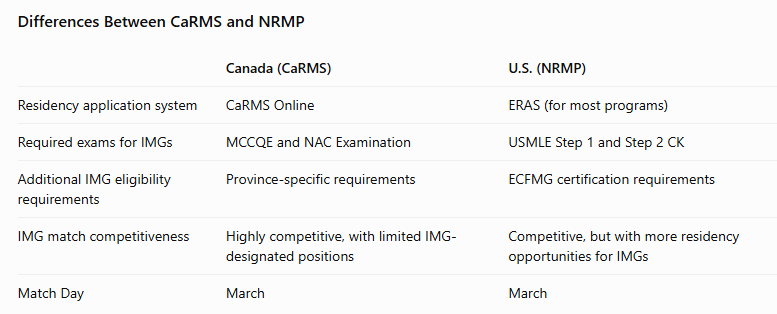
For many IMGs, including Trinity graduates, Canadian and U.S. residency pathways share some milestones, but they differ in how students qualify and apply for residency. For example, Trinity students take USMLE Step 1 and Step 2 CK regardless of where they plan to match, while students pursuing residency in Canada must also account for CaRMS, Canadian examinations, and province-specific IMG requirements.
What Changes When You Apply for Residency in Canada?
For Caribbean medical school graduates applying for residency in Canada, some of the biggest differences include:
- You apply through CaRMS. The Canadian Resident Matching Service (CaRMS) administers the primary match for entry into Canadian residency programs, while the National Resident Matching Program (NRMP) administers the main residency match in the United States.
- You apply as an IMG. Trinity graduates are classified as international medical graduates for the Canadian residency match. This affects which residency positions are available and which eligibility criteria you must meet.
- You must meet citizenship or residency requirements. IMG applicants generally must be Canadian citizens or permanent residents, although certain exceptions may apply.
- You need to plan for Canadian examinations. IMG applicants to the CaRMS R-1 Match generally need to pass both the Medical Council of Canada Qualifying Examination (MCCQE) and the National Assessment Collaboration (NAC) Examination.
- Eligibility can vary by province. Provinces establish additional criteria for IMG applicants, so being eligible for residency positions in one province does not necessarily mean you will meet the requirements for every other province. Individual residency programs may have additional requirements as well.
Can You Apply to Both CaRMS and NRMP?
Students who meet the requirements for both systems can participate in the Canadian and U.S. residency matches during the same application cycle. However, you cannot ultimately match into residency positions in both countries.
NRMP and CaRMS have an agreement that allows students to participate in both matches. However, if a student matches into a residency position in one country, they are automatically withdrawn from the other country's match. For the 2027 cycle, CaRMS results are scheduled to be released first, so applicants who match through the CaRMS R-1 Match will automatically be withdrawn from the NRMP Main Residency Match.
If you are considering both pathways, understanding the match calendar early can help you decide how Canadian and U.S. residency applications fit into your overall strategy.
Exams You Need to Take to Prepare for Canadian Residency
The Canadian residency pathway requires Trinity students to plan for more than one examination system. USMLE Step 1 remains part of progression through Trinity’s MD program, while students pursuing residency through CaRMS also need to prepare for the Medical Council of Canada Qualifying Examination (MCCQE) and the National Assessment Collaboration (NAC) Examination.
The Canadian exams serve different purposes: the MCCQE focuses on medical knowledge and clinical decision-making, while the NAC evaluates how you apply clinical skills in patient encounters.
USMLE Step 1
Trinity students take USMLE Step 1 during Term 5, before beginning core clinical rotations. That remains true whether your long-term residency goal is Canada or the United States.
For Canadian students, however, passing Step 1 does not replace the examinations used for the CaRMS IMG process. You will need to build the MCCQE and NAC Examination into your medical school timeline as well.
The MCCQE
The Medical Council of Canada Qualifying Examination (MCCQE) assesses the medical knowledge and clinical decision-making expected of a student completing a medical degree in Canada. For an IMG pursuing Canadian residency, passing the MCCQE is generally part of the basic eligibility requirements for the CaRMS R-1 Main Residency Match, although provincial exceptions can apply.
Unlike an exam organized primarily around individual organ systems, the MCCQE uses clinical scenarios across disciplines. That means preparation should account not only for medical knowledge, but also for how that knowledge is applied in a Canadian clinical context.
MCCQE at a Glance
- Format: 230 multiple-choice questions divided into two sections of 115 questions.
- Length: Up to 2 hours and 40 minutes for each section, with an optional break between them.
- Score range: 300 to 600.
- Passing score: 439.
- What it tests: Medical knowledge and clinical decision-making across dimensions of care and physician activities.
- When to plan for it: Trinity students can typically take the MCCQE during the clinical portion of the MD program, around the same general stage as USMLE Step 2 CK. The exact CaRMS deadlines vary by application cycle, so the exam should be scheduled early enough for your result to be available when required.
How Much Does Your MCCQE Score Matter?
A passing score establishes an important eligibility baseline, but passing and being competitive are not necessarily the same thing. Residency programs evaluate applicants using multiple factors, and there is no universal MCCQE score that guarantees an interview or makes you competitive for a particular specialty.
Canadian students should aim well beyond the minimum passing score. Under the current scoring system, a score of 500+ represents strong performance, while scores in the 520s and above reflect particularly high achievement. Although these scores may help strengthen an application, individual residency programs evaluate examination results differently, and no specific score guarantees an interview or match.
The NAC Examination
The NAC Examination tests a different side of your readiness for Canadian residency. Rather than answering written multiple-choice questions, you move through a series of clinical stations in an Objective Structured Clinical Examination, or OSCE. The goal is to assess whether you can demonstrate the knowledge, clinical skills, communication, and professional judgment expected when entering residency in Canada.
For a standard administration, the exam includes 12 stations, including two pilot stations that do not count toward your final score. Each station lasts 11 minutes, with two minutes between stations. Scenarios may require you to take a history, perform or describe a focused physical examination, develop a differential diagnosis, explain a management plan, or communicate with a patient.
NAC Examination at a Glance
- Format: Half-day, hands-on OSCE.
- Stations: 12 total, including two unscored pilot stations.
- Timing: 11 minutes per station with two minutes between stations.
- Score range: 500 to 700.
- Passing score: 577.
- What it tests: Skills including history-taking, diagnosis, management, physical examination, investigations, data interpretation, and communication.
- When to take it: The NAC is generally offered in the spring and fall. Students planning for CaRMS need to choose an administration early enough for results to be available for their application cycle.
As with the MCCQE, there is no single NAC score that guarantees a residency position; however, a score of 602+ is a good target for building a competitive application. Programs assess NAC performance alongside your broader academic record, Canadian clinical experience, references, specialty fit, and other application factors.
How to Prepare for the NAC Examination
Because the NAC evaluates what you do during a clinical encounter, preparation should involve more than reviewing medical content. Strong preparation includes practicing the behaviors and decision-making you will need to demonstrate under a strict time limit.
- Practice realistic, timed stations. Eleven minutes can pass quickly. Mock OSCEs help you learn which information to prioritize while still leaving enough time to explain your reasoning and plan.
- Focus on patient-centered communication. Clear explanations, active listening, appropriate language, and confirming patient understanding are all part of the assessment.
- Develop a repeatable approach. A consistent framework for moving from the presenting problem through history, examination, assessment, and management can help you use limited station time efficiently.
- Seek specific feedback. Practice with experienced clinicians can uncover communication habits, missed clinical steps, or problems with pacing that are difficult to identify when practicing alone.
Seemingly minor elements of clinical professionalism, such as consent, hand hygiene, patient comfort, and explaining what you are doing during an examination, can affect your performance. The exam evaluates not only whether you reach an appropriate clinical conclusion, but how safely and professionally you interact with the patient along the way.
The CaRMS Application Process Step by Step
The CaRMS IMG process begins well before you submit residency applications. Exam results, credential verification, and province-specific requirements can all affect where you are eligible to apply, and some of these steps can take months to complete. Starting early gives you more time to address delays without limiting your options for a particular match cycle.
Exact dates change from year to year, but the process typically follows these steps.
1. Create Your physiciansapply.ca Account
One of your first steps is creating an account with physiciansapply.ca, the Medical Council of Canada’s online portal for Canadian and international medical students and graduates. You will use it to access services such as applying for the MCCQE and NAC Examination, submitting credentials for source verification, and sharing exam results and documents with participating organizations.
Setting up your account early also establishes your profile within the Canadian medical system. Caribbean medical students planning to enter the Canadian residency match should not wait until CaRMS applications open to complete this step.
2. Start Source Verification Early
International medical credentials may need to go through source verification, a process in which the Medical Council of Canada confirms the authenticity of a credential with the institution that issued it. Source Verification Requests, or SVRs, are submitted through physiciansapply.ca.
There is no guaranteed processing time. Once a credential is sent to the issuing institution, the MCC notes that the institution’s response can take three months or longer. For that reason, submit required credentials for verification as soon as you are eligible to do so.
3. Complete the MCCQE and NAC Examination by the Required Deadlines
The MCCQE and NAC Examination should already be part of your planning by the time you begin preparing a CaRMS application. For most IMGs, these examinations are required for participation in the R-1 Main Residency Match.
The important deadline is not the date CaRMS Online opens. Your results must be available when required by CaRMS, the province, and the individual programs where you intend to apply. Some provincial IMG processes have earlier deadlines of their own.
Why Timing Examinations is Important
Missing an examination or provincial eligibility deadline can prevent you from applying to certain residency positions or participating in that match cycle. Work backward from the requirements for your intended match year rather than waiting for CaRMS applications to open.
At Trinity, the MCCQE and NAC Examination generally fit into the clinical portion of the MD program, around the same stage that students prepare for USMLE Step 2 CK.
4. Check Province-Specific IMG Requirements
Qualifying for the CaRMS R-1 Match does not automatically make you eligible for every residency position in Canada. Provinces and individual programs can establish additional requirements involving assessments, examinations, language proficiency, citizenship or permanent-resident status, and other eligibility criteria.
Review the requirements for every province and program you are considering well before application deadlines. Some provincial processes must be completed in advance, so identifying those requirements early can help you avoid losing eligibility for positions you hoped to pursue.
5. Build and Submit Your CaRMS Application
Once CaRMS Online opens for your match year, you can begin building your application and reviewing participating programs. For the 2027 first iteration, for example, CaRMS Online opened September 9, program selection began October 15, and applications and required documents are due for on-time submission before file review begins November 26. Dates change each year, so always use the timeline for your specific cycle.
Depending on the program, your application materials may include:
- Medical school transcript
- Medical Student Performance Record (MSPR)
- Personal statements or other program-specific written materials
- Reference letters
- MCCQE and NAC Examination results
- Verified credentials and other eligibility documents
- Additional assessments or documents required by the province or residency program
IMG applicants transfer their MCC examination data and NAC results to CaRMS through physiciansapply.ca.
Completing the basic application requirements is only part of building a competitive file. Canadian clinical experience, strong references, specialty-specific preparation, and how you present your reasons for pursuing residency in Canada can also influence how programs evaluate your application.
6. Complete Interviews, Rank Programs, and Wait for Match Day
After file review begins, programs determine which applicants they want to interview. While current-year Canadian medical graduates generally follow a national interview period when interviewing with programs outside their home medical school, IMG interviews are scheduled separately by individual residency programs. As a result, your interview timeline can vary depending on where you apply.
Applicants then rank the programs where they would be willing to train, and residency programs rank applicants. CaRMS uses those rank-order lists to determine matches.
For the 2027 first iteration, the sequence is:
- September: CaRMS Online opens.
- October: Program selection begins.
- Late November: Applications are due for on-time submission and program file review begins.
- Winter: IMG interviews are scheduled by individual programs.
- January and February: Applicants prepare and submit rank-order lists.
- March: First-iteration Match Day takes place.
Applicants who do not match in the first iteration may be able to pursue remaining positions in the second iteration, provided they meet the eligibility requirements for those programs.
It’s important to plan backward from the match cycle. Credential verification, Canadian exams, and provincial assessments can all require action months before residency programs begin reviewing applications. For an IMG hoping to match in Canada, staying informed about those requirements and deadlines may keep more residency options open.
How Province Choice Affects Your Chances
CaRMS is a national residency matching service, but opportunities for IMGs are not distributed uniformly across Canada. Provinces help determine how many IMG-designated residency positions are available, which specialties offer them, and what additional eligibility requirements applicants must meet. As a result, a national IMG match rate cannot tell you how competitive you may be for a particular province, specialty, or program.
For students navigating the Canadian IMG residency pathway, province choice is an important part of the application strategy. The number and type of opportunities available can change depending on where you are willing to train and eventually practice.
How IMG Residency Opportunities in Canada Differ From Province to Province
IMG residency opportunities can vary significantly depending on the province and program you are considering. When comparing your options, pay particular attention to:
- Which specialties have IMG positions. A province may offer IMG positions in Family Medicine or Internal Medicine without offering comparable access across every specialty.
- Additional eligibility requirements. Provincial assessment, language, examination, or other requirements can affect whether you are able to apply.
- Program-specific criteria. Even after meeting provincial requirements, individual residency programs can establish additional criteria for applicants.
- Return-of-Service requirements. Some IMG positions require a commitment to practice in a designated community or region after residency.
Some Provinces Require Additional Steps
Because the Canadian residency pathway for IMGs is not identical from one province to another, it is important to research each province and individual residency program before building your CaRMS strategy. Examples of how provincial IMG pathways can differ include:
- Manitoba, Saskatchewan, and Newfoundland and Labrador: These provinces have established IMG residency pathways, particularly in areas connected to regional physician workforce needs. These provinces may provide additional opportunities for IMGs who are geographically flexible.
- Ontario: Ontario offers IMG opportunities across multiple medical schools and specialties. A broader range of programs does not necessarily mean an easier match, however, because competition remains significant and applicants still need to meet the eligibility requirements of each program they pursue.
- Alberta: Alberta requires IMG applicants pursuing designated positions to complete the Alberta International Medical Graduate (AIMG) process before applying through CaRMS.
- British Columbia: For Caribbean medical students and other IMGs, British Columbia is a particularly competitive environment. Additionally, British Columbia requires IMGs pursuing first-year residency positions to complete the Clinical Assessment Program (CAP), which adds an additional screening step before the match.
- Quebec: Quebec has its own medical degree equivalency and provincial regulatory requirements. Language requirements can also affect which programs are realistic options for an IMG.
IMG applicants should not assume that eligibility in one province carries over automatically to another. Provincial requirements and available residency positions can change from one match cycle to the next, so current CaRMS criteria and individual program descriptions should always guide where you apply.
Understand Return-of-Service Before You Apply
Many IMG-designated residency positions include a Return-of-Service (ROS) agreement, which requires you to practice in an eligible community or region after completing residency. The exact commitment varies by province and program, and agreements can involve multiple years of service in designated underserved areas.
Before applying to or ranking an ROS position, make sure you understand:
- How long the commitment lasts.
- Where you may be required to practice.
- Which specialties and positions carry an ROS requirement.
- What happens if you do not fulfill the agreement.
Being open to multiple provinces and, where appropriate, an ROS commitment can expand the number of residency options available to you. Geographic flexibility does not guarantee a match, but restricting yourself to one province or city can substantially narrow an already limited pool of IMG positions.
What Makes an IMG Competitive in the Canadian Match Process?
Meeting CaRMS eligibility requirements allows you to apply for residency, but eligibility alone does not make an application competitive. Strong Canadian IMG applications typically combine solid exam performance with relevant clinical experience, excellent references, and application materials that show you are prepared to train in the Canadian healthcare environment.
Canadian Clinical Experience Is a Major Differentiator
Canadian clinical experience is one of the strongest ways to demonstrate that you can work effectively within the environment where you hope to complete residency. It can also help you build relationships with physicians who may later provide meaningful references.
Canadian clinical experience can help you:
- Become familiar with Canadian clinical expectations and practice norms.
- Demonstrate your clinical skills directly to Canadian physicians.
- Develop stronger specialty-specific reference letters.
- Show programs that you have made a deliberate effort to prepare for residency in Canada.
For Caribbean medical students, completing clinical electives in Canada is one of the most effective ways to gain relevant experience before applying through CaRMS.
Aim for Above-Average Exam Scores
Exam scores are an important part of your file. A score of 500+ on the MCCQE and 602+ on the NAC Examination can serve as useful planning benchmarks for students aiming to strengthen their residency applications.
Higher MCCQE and NAC scores can strengthen your file and help demonstrate academic and clinical readiness, while Canadian experience, references, and communication skills give programs additional context for how you may perform in residency.
Strong Canadian References Add Credibility
Reference letters are most useful when they come from physicians who have directly observed your clinical work and can speak specifically about your readiness for residency. Strong letters may address qualities such as:
- Clinical ability and judgment
- Communication and professionalism
- Readiness for your chosen specialty
Canadian clinical experiences are valuable because they give physicians within the Canadian system an opportunity to assess your work firsthand.
Write for Canadian Programs
If you are applying through both CaRMS and NRMP, avoid simply repurposing a U.S.-focused personal statement for Canadian programs. Your CaRMS materials should reflect why you want to train in Canada and why the specific programs you are pursuing fit your goals.
A strong Canadian-focused statement should help programs understand:
- Why you want to complete residency in Canada.
- Why the particular specialty, program, or province interests you.
- How your experiences have prepared you for Canadian postgraduate training.
Professionalism, ethics, communication, and a clear connection to your goals in Canada should come through naturally in the application. The strongest files show programs that you are prepared for the demands of Canadian residency.
How the Canadian Residency Pathway Fits Into Trinity’s MD Program
The Canadian pathway works best when CaRMS preparation is built into your medical school timeline. At Trinity, the major Canadian residency milestones can be planned alongside basic sciences, USMLE preparation, clinical rotations, and electives.
Terms 1–4: Build Your Foundation on St. Vincent
During Terms 1 through 4, you complete Trinity’s basic sciences curriculum on St. Vincent. This is also a good time to begin building the experiences that will eventually support your residency application.
Priorities during this stage include:
- Taking advantage of early clinical experiences to strengthen your skills and CV.
- Beginning to think about potential specialties and where you may want to pursue residency.
- Learning about the Canadian exams and CaRMS requirements you will need to complete later in the program.
Term 5: Complete USMLE Step 1 and Start Planning for Canadian Residency Applications
During Term 5, Trinity students prepare for and take USMLE Step 1 before moving into core clinical rotations.
Around this stage, Canadian students can also begin putting the administrative pieces of the Canadian pathway in place. That includes creating a physiciansapply.ca account, determining when they will become eligible to apply for the MCCQE and NAC Examination, and planning for other requirements such as obtaining a Medical Identification Number for Canada (MINC).
Year 3: Complete Core Rotations and Plan Your Canadian Exams
Year 3 includes 48 weeks of core clinical rotations, giving you the clinical foundation needed for the next set of examinations. Around the end of core rotations, key milestones include:
- Taking USMLE Step 2 CK.
- Scheduling the MCCQE.
- Scheduling the NAC Examination.
The MCCQE and NAC can be taken around the same general stage of your medical education as Step 2 CK, but exact timing should reflect the requirements for the match cycle and provinces where you plan to apply.
Year 4: Use Electives Strategically
Trinity students complete 27 weeks of elective rotations during Year 4. For students pursuing residency in Canada, electives can be an important opportunity to build the Canadian clinical experience that strengthens a CaRMS application. When planning electives:
- Coordinate with Trinity’s clerkship coordinator as you pursue opportunities in Canada within your preferred specialty.
- Use the AFMC Portal to identify available Canadian electives.
- Prioritize experiences that align with your specialty interests and can help you build meaningful relationships with Canadian physicians.
Completing clinical electives in Canada can strengthen more than one part of your application at once by adding relevant clinical experience and creating opportunities for specialty-specific references. Availability and eligibility requirements for Canadian clinical electives vary by institution, so students should research opportunities early and work with Trinity's clerkship team to determine their options.
Before the Match: Confirm the CaRMS and NRMP Timelines
If you plan to apply for residency in both Canada and the United States, review the CaRMS and NRMP calendars for your specific match year. The order of the two matches matters because matching through the system that runs first affects your participation in the other.
Mapping these milestones onto the Trinity MD timeline makes the Canadian pathway easier to manage. Instead of approaching CaRMS as a separate process at the end of medical school, you can build the exams, clinical experiences, electives, and application requirements into your progression toward residency.
Prepare for a Future in Canadian Medicine
With the right preparation, Canadian students attending Trinity School of Medicine can build a realistic pathway toward residency and, ultimately, medical practice in Canada. Preparing for Canadian exams, gaining clinical experience in Canadian healthcare settings, and understanding province-specific requirements and CaRMS deadlines can help you approach each stage with a clear plan and support from Trinity along the way.
If you are considering Trinity and want to better understand how the Canadian pathway could fit into your medical education, speak with an admissions counselor. They can help you explore the MD program, discuss your long-term goals, and answer questions about preparing for residency in Canada.


